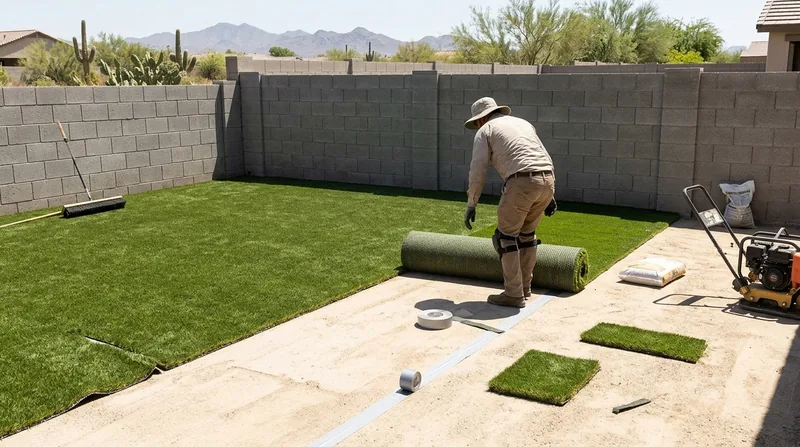




Residential artificial grass installation in Phoenix transforms dying bermuda lawns and bare dirt yards into dense, realistic turf built for 115 degree summers. Across the Salt River Valley, from mid-century red-brick ranches in Arcadia to newer two-story stucco subdivisions ringing Anthem and Buckeye, single-story homes sit on slab-on-grade lots with block walls between every backyard. Most front yards follow HOA rules on color, pile height and edging. Most backyards have pools, citrus trees, saguaros and hard desert light with the McDowells and South Mountain on the horizon. Real grass struggles in that heat and shade. We install artificial turf installation with compacted base, drainage tested, edges anchored, infill brushed in, and a written spec in your hand so you know exactly what you bought.
Why Residential Artificial Grass Installation Matters in the Phoenix Heat
Phoenix summers exceed 115 degrees for weeks on end. Real bermuda grass browns out, roots shallow in the heat, and watering bills climb past $200 a month in July and August. Bare dirt yards collect dust, dust storms coat everything, and gravel front yards conflict with HOA rules in most subdivisions. Artificial turf stays green year-round, never needs mowing, watering or fertilizer, and handles the heat without scorching or thinning. A well-installed turf system with proper base prep, drainage and infill selection performs for 15 to 20 years in Arizona sun.
- Real grass in Phoenix heat requires constant watering, fertilizer, and replacement every 3 to 5 years.
- Artificial turf needs no irrigation, no chemicals, and no seasonal replanting.
- HOA architectural review typically governs front-yard turf color, pile height and edging, so a written spec from your installer is essential for submittal.
- Base preparation and drainage testing prevent water pooling, root rot and premature failure in monsoon season.
- Infill selection (crumb, sand, zeolite or antimicrobial blends) affects pet safety, odor control and heat reflection.
Getting these details right at install time is what separates a 20-year yard from a failed one.
Key info: Phoenix HOAs often require pre-approval of front-yard turf. We help prepare architectural submittals naming the turf product, face weight, pile height and color, but approval is the HOA's decision. Always check your CC&Rs and submit before installation begins. See the City of Phoenix planning and zoning page for HOA disclosure and architectural review procedures in your neighborhood.
How We Install Residential Artificial Grass in Phoenix Yards
Every installation starts with a site visit and written spec. We measure the yard, identify drainage issues, check for utilities, assess shade and sun exposure, and discuss your budget and timeline. We remove old grass or gravel, grade and compact the base, test drainage, lay the turf, secure edges with landscape nails or adhesive, brush infill into the pile, and leave you with a written record of the turf product, face weight, pile height, infill type and base depth. This transparency is how you verify any turf installer, including us.
- Site visit: measure the yard, identify utilities, shade, drainage and access constraints.
- Remove old grass, gravel or debris and dispose of it off-site.
- Grade the base to slope away from structures and toward drainage points.
- Compact the base to 95% density with a vibratory plate.
- Test drainage by pouring water and observing flow and absorption.
- Lay landscape fabric to prevent weed growth and separate infill from base soil.
- Roll out turf, cut to fit edges and corners, and seam seams with adhesive.
- Secure perimeter edges with landscape nails or concrete-safe adhesive.
- Broadcast infill evenly across the turf and brush it into the pile with a power brush.
- Final walk-through, cleanup and written spec in your hands.
A typical residential yard in Phoenix or Paradise Valley takes 2 to 4 days depending on size, access and base condition.
Example: A 600-square-foot backyard in Arcadia with compacted caliche base and good drainage takes 2 days. A 1,000-square-foot front and side yard in Anthem with poor drainage and three citrus trees takes 3 to 4 days because base grading, drainage testing and tree-root avoidance add time. We always schedule on-site before quoting a timeline. Call our contact page for a free estimate.
Installation Methods and When Each Works Best
| Approach | Description | Best for |
|---|---|---|
| Compacted mineral base with landscape fabric | Grade and compact native caliche or imported base material to 95% density, lay fabric, install turf and infill. | Most Phoenix residential yards where drainage is good and slab is not exposed. |
| Porous pavers or turf strips over concrete | Lay porous pavers or turf-paver strips on concrete slab, install turf on top, infill as normal. | Patios, pool surrounds and hardscape conversion where you keep the slab but want green space. |
| Raised perimeter with internal base prep | Build a low wood or metal edge, fill with compacted base, install turf and infill inside the frame. | Yards with poor drainage, sloping terrain or where existing grade cannot be changed. |
| Seam and edge reinforcement | Use turf-grade seam adhesive, overlap turf seams by 1 to 2 inches, and secure perimeter with nails or adhesive every 6 to 8 inches. | All installations, especially high-traffic areas, pet yards and yards with heavy wind exposure. |
Each method is chosen based on site conditions, drainage, existing grade and your long-term use. We inspect and recommend on-site.
Residential Artificial Grass Installation Cost in Phoenix: What to Expect
Artificial turf installation cost in Phoenix starts at around $8 per square foot for a standard residential installation with a quality turf product, compacted base, landscape fabric and infill. A 600-square-foot backyard runs roughly $4,800 to $6,000 before any site-specific work. A 1,000-square-foot combined front and back yard ranges from $8,000 to $12,000 depending on base condition, tree roots, drainage issues and infill type. Cost per square foot rises when the yard has poor drainage that requires excavation, tree roots that demand careful avoidance, slopes that need grading, or when you choose a premium turf product or specialty infill like antimicrobial zeolite for pet yards.
Getting 2 to 3 estimates is smart because each installer may recommend different base depths, infill types and turf products. Always ask for a written spec that names the turf product, face weight in ounces per square yard, pile height in millimeters, infill type and pounds per square foot, and base depth. A low bid without a spec is a red flag. For a detailed pricing breakdown by yard size and turf type, see our full pricing page.
What to Look for When Hiring a Turf Installation Company Near Me in Phoenix
Turf work is straightforward but details matter. A cheap install on bare dirt with no base prep fails in 3 to 5 years. A professional turf installer in Phoenix or Paradise Valley will give you a site visit, a written spec, a realistic timeline and a certificate of insurance naming general liability and workers compensation. Ask for references, photos of finished work in Phoenix heat, and proof of insurance before signing a contract.
If your yard has an HOA, check your CC&Rs for architectural review requirements and ask the installer to help you prepare a submittal. If your property is near a protected tree or in a sensitive drainage area, ask the installer whether a permit is required from the City of Phoenix or your county. Most turf itself does not require a permit, but grading that changes drainage or work in a right-of-way may. Always defer to the local building department and never sign a contract that promises something the city has not approved. Request Arizona 811 utility locates before any base excavation begins, and understand that private lines like irrigation, low-voltage lighting and pet-fence wires are not marked by locates and must be identified on-site. Contact us for a free estimate and we will walk you through every step.
Residential Artificial Grass Installation in Phoenix: Pricing Guide
| Service | Price | Details |
|---|---|---|
| Standard residential installation | Starting at $8/sq ft | Quality turf, compacted base, landscape fabric, infill and edges. Cost per square foot rises with poor drainage, tree roots or specialty infill |
| Small yard (400 to 600 sq ft) | $3,200 to $4,800 | Typical backyard with good access and level grade. Includes base prep, turf, infill, edges and written spec |
| Medium yard (600 to 1,000 sq ft) | $4,800 to $8,000 | Front and back combined or large single area. Base prep, drainage testing, turf, infill and written spec included |
| Large or complex yard (1,000+ sq ft) | On estimate | Poor drainage, tree roots, slopes or specialty turf require on-site assessment before pricing. Call for a free estimate |
| Travel and estimate | Included and free | No mileage fee or travel charge in Phoenix and surrounding service areas. Free estimate within 24 hours at (602) 387-6265 |
Indicative pricing, the exact cost depends on square footage, finish, and site access. Free personalized estimate within 24h at (602) 387-6265.


